The Quest for Artificial General Intelligence: Why the Answer May Lie in the Human Brain
Introduction
In the quest to build Artificial General Intelligence (AGI), many researchers have turned to ever-larger transformer models, hoping to brute-force their way into human-like cognition. And while these systems — like GPT-4, Claude, and Gemini — are undeniably impressive, they remain fundamentally limited. Despite their scale, they lack the fluid focus, self-directed learning, contextual awareness, and adaptability of a human brain.
So what if we’re chasing AGI using the wrong substrate entirely?
What if the answer isn’t more GPU, but less silicon?
The Evolution of AI Techniques
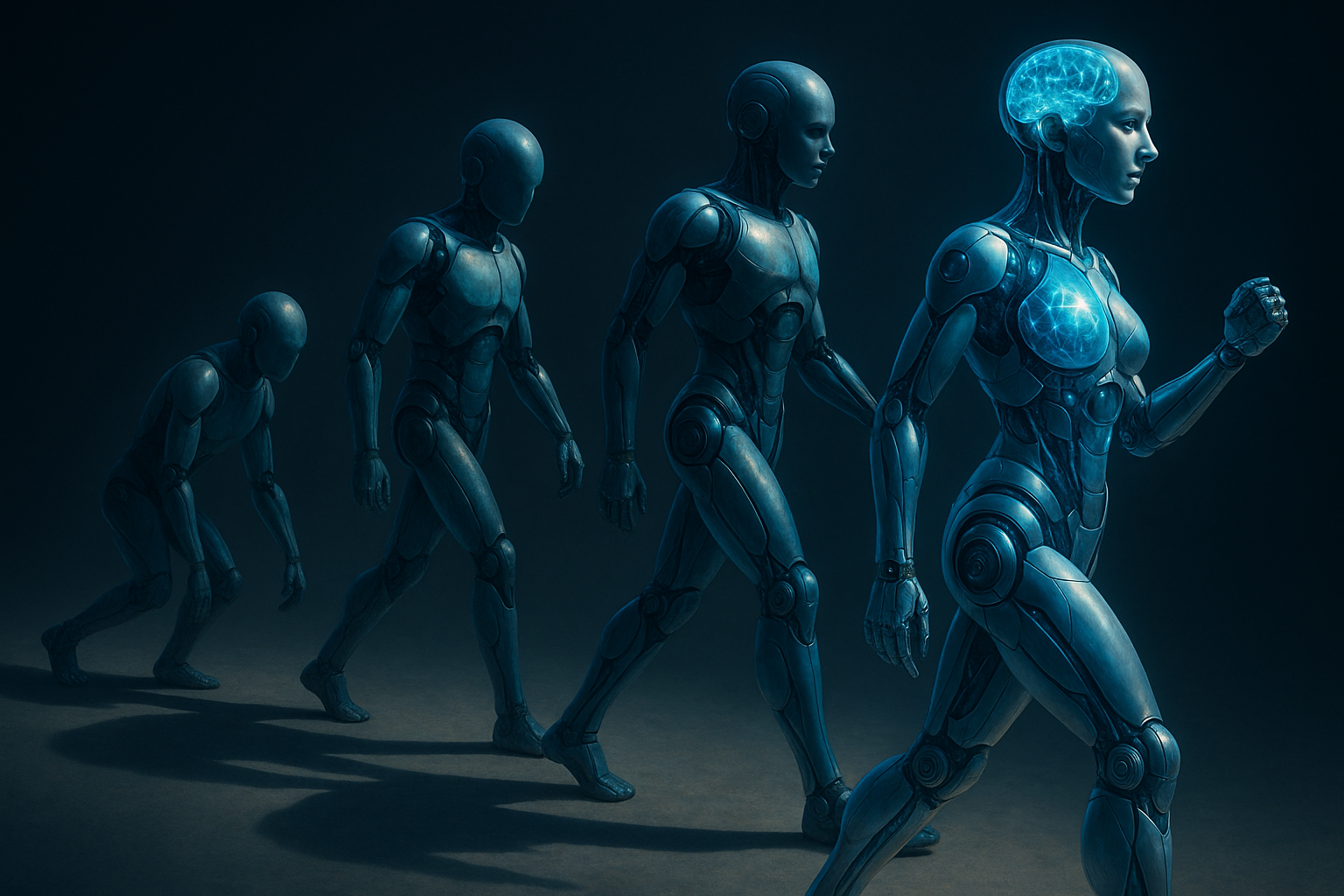
To understand where AGI is going, it's worth reflecting on where artificial intelligence has been. AI’s journey has unfolded in generations of breakthroughs, each solving new challenges while revealing new limitations.
1. Symbolic AI (1950s–1980s)
Key players: Allen Newell, Herbert Simon, John McCarthy (who coined "Artificial Intelligence").
Approach: Based on logic, rules, and symbols — essentially programming intelligence by hand.
Techniques: Search trees (step-by-step decision paths), if-then rules, and logic programming languages like Prolog.
Practical applications: Early expert systems for medical diagnosis and logistics planning.
Milestone: Development of SHRDLU (1970), a program that could manipulate blocks using typed English commands.
Why it matters: SHRDLU showed that computers could understand and act on natural language in a limited environment, sparking early interest in AI's potential.
Limitations: These systems were brittle — they broke easily when faced with real-world messiness or ambiguity.
2. Statistical & Machine Learning (1980s–2000s)
Key players: Judea Pearl (Bayesian networks), Vladimir Vapnik (support vector machines or SVMs).
Approach: Learn patterns from data using statistical methods instead of hand-written rules.
Techniques: Decision trees, naive Bayes, SVMs (models that find the best dividing line between data classes).
Practical applications: Spam filters, fraud detection, handwriting recognition.
Milestone: Use of benchmark datasets like MNIST and adoption of cross-validation methods.
Why it matters: These tools helped standardize and measure machine learning progress across different models, accelerating research and real-world adoption.
Limitations: Still needed humans to pick the right features or inputs to learn from (called "feature engineering").
3. Deep Learning (2010s–Present)
Key players: Geoffrey Hinton, Yann LeCun, Yoshua Bengio.
Approach: Use deep neural networks — layered systems that mimic how neurons work — to learn patterns automatically.
Techniques:
Convolutional Neural Networks (CNNs): Specially designed for images, CNNs scan small portions of the image using filters to detect things like edges, shapes, or patterns — similar to how our visual cortex works.
Recurrent Neural Networks (RNNs): Designed for sequences (like text or audio). RNNs have loops that allow them to keep track of previous inputs, which helps in understanding context. However, they often struggle with long-term memory.
Long Short-Term Memory networks (LSTMs): A type of RNN designed to remember things for longer. LSTMs use special gates to control what information gets stored, forgotten, or passed along — like a smarter memory controller.
Transformers: A newer architecture that uses attention to look at all input data at once, rather than step-by-step like RNNs.
Practical applications: Image recognition, speech recognition, automatic translation, chatbots.
Milestones:
AlexNet (2012): Won the ImageNet competition and triggered the deep learning boom.
Why it matters: It demonstrated that deep neural networks could outperform traditional models on large-scale image recognition — a turning point for modern AI.
"Attention Is All You Need" (2017): Introduced the Transformer architecture.
Why it matters: Transformers became the foundation for almost all advanced language models today, enabling breakthroughs in translation, coding, and dialogue systems.
Limitations: Requires massive data and computing power. Struggles with generalizing to new types of tasks without retraining.
4. Foundation Models (2018–Present)
Key players: Google (BERT), OpenAI (GPT series), Anthropic (Claude), Meta (LLaMA), Microsoft (Copilot integrations).
Approach: A foundation model is a large, general-purpose AI trained on a massive dataset and adaptable to many different tasks.
Techniques: Large-scale pretraining using Transformers, followed by task-specific fine-tuning or prompting.
Practical applications: Chatbots, writing assistants, code generation, summarization, customer service automation.
Milestones:
BERT (2018): A model that reads entire sentences in both directions.
Why it matters: BERT significantly improved how machines understand language and context, boosting search and comprehension tasks.
GPT-2 and GPT-3 (2019–2020): Large autoregressive models trained to predict the next word.
Why it matters: GPT showed that with enough data and size, models could generate fluent, human-like text — opening doors to general-purpose language agents.
Widespread integration in tools like Google Search and Microsoft Copilot.
Why it matters: Foundation models transitioned from labs to everyday tools, transforming productivity and workflows across industries.
Limitations: Very expensive to train. Can still make things up (hallucinate), miss context, or reinforce biases in training data.
5. Reinforcement Learning (1990s–Present)
Key players: Richard Sutton, Andrew Barto, DeepMind, OpenAI.
Approach: A method where AI learns through trial and error, guided by rewards and punishments — like training a dog with treats.
Techniques:
Q-learning: Learn what actions to take in each situation.
Policy gradients: Adjust the AI's behavior directly to improve rewards.
Actor-critic models: Combine decision-making and feedback into one loop.
Practical applications: Robotics, autonomous vehicles, game-playing agents.
Milestones:
TD-Gammon (1992): Used reinforcement learning to become a world-class backgammon player.
Why it matters: Proved that learning strategies purely from experience was viable, even in complex decision-making games.
AlphaGo (2016): Beat a world champion at the game of Go.
Why it matters: Go had been considered too complex for AI. AlphaGo demonstrated how deep RL and planning could conquer such domains.
OpenAI Five (2018): Beat professional human teams in Dota 2.
Why it matters: Showed that multi-agent reinforcement learning could coordinate in dynamic, strategic team environments.
Limitations: Requires tons of training — often millions of tries. Doesn't adapt well to new or changing environments without retraining.
6. Neuro-Symbolic AI (Emerging)
Key players: IBM Research, MIT-IBM Watson Lab, DeepMind, Stanford.
Approach: Combines the logic and rules of symbolic AI with the pattern-matching power of neural networks.
Techniques: Hybrid models that integrate rule-based reasoning with deep learning components.
Practical applications: Legal reasoning, structured question answering, explainable AI.
Milestones:
IBM’s TrueNorth chip (2014): Simulated one million neurons and 256 million synapses.
Why it matters: Proved that large-scale brain-like networks could run efficiently in hardware.
Intel’s Loihi 2 chip (2021): Added on-chip learning and enhanced parallelism.
Why it matters: Brought brain-like learning closer to real-world use in edge devices and robotics.
Development of open-source frameworks: Lava, Nengo, and Brian2.
Why it matters: Helped build a research community around bridging deep learning and symbolic logic.
Limitations: Still early-stage; building scalable systems remains a challenge.
7. Neuromorphic & Brain-Inspired AI (The Horizon)
Key players: Intel (Loihi chips), IBM (TrueNorth), University of Manchester (SpiNNaker), SynSense, BrainChip.
Approach: AI that mimics the structure and behavior of the human brain, especially neurons and synapses.
Techniques:
Spiking Neural Networks (SNNs): These work more like real brain cells — instead of passing values continuously like regular neural networks, they "spike" or fire only when certain thresholds are reached. This makes them more energy-efficient and better at handling time-based patterns.
Event-driven logic: Instead of running constantly like a clock, these systems only do work when an event happens — like a sensor detecting motion.
On-chip learning: The system can learn and adapt directly in the hardware, similar to how a brain adjusts its wiring.
Practical applications: Low-power robotics, smart sensors, edge AI.
Milestones:
Limitations: Hardware is still experimental, and ecosystem support is growing but immature.
The Quest for Artificial General Intelligence
Software Perspective
Human Brain vs. Transformer Models
Transformers—like GPT, BERT, and T5—revolutionized machine learning by introducing self-attention, a mechanism that allows each input token to dynamically weigh the importance of other tokens.
Key Features of Transformer Models
Self-attention: Enables models to learn contextual relationships efficiently.
Positional encoding: Adds sequence information without recurrence.
Parallel computation: All tokens are processed simultaneously, improving training speed.
Key Limitations of Transformer Models
Limited context window: Models like GPT-4 have a maximum token limit (e.g., 128K). The brain maintains and updates context over an entire lifespan.
Statelessness: Transformers have no intrinsic memory; past interactions must be re-fed. The brain has persistent, layered memory systems.
Lack of embodiment: Transformers do not interact with the real world or possess sensory-motor feedback loops.
Comparison of the Human Brain & Transformer Models
Context Length
Brain: Lifelong memory, integrated across time
Transformer: Limited context window (e.g., 128K tokens)
Plain English: Brain remembers your life; transformers only see a few pages
Memory
Brain: Persistent and layered (short, long-term)
Transformer: Stateless; no memory beyond prompt
Plain English: Brain keeps memory; transformers forget after each chat
Attention Mechanism
Brain: Biochemically modulated focus
Transformer: Self-attention over all tokens
Plain English: Brain uses chemical signals to focus; transformers do brute-force matching
Learning Style
Brain: Life-long, embodied, multi-modal
Transformer: Pre-trained and fixed unless re-trained
Plain English: Brain always learns; transformers stop learning after training
Feedback Loops
Brain: Extensive and recursive
Transformer: Minimal or none
Plain English: Brain constantly loops back; transformers don’t
Human Brain vs Deep Reinforcement Learning Models
DRL algorithms learn policies by optimizing cumulative reward. Popular methods include DQN, PPO, and A3C.
Strengths of DRL Models
Environment interaction: Agents learn by trial and error.
Value functions and policies: Agents build estimations to guide action.
Exploration vs. exploitation trade-off: Balance between trying new actions and leveraging known ones.
Limitations of DRL Models
Reward signal processing: The brain uses rich, nuanced neuromodulators (e.g., dopamine) that adaptively shape learning across multiple timescales. DRL often relies on sparse, scalar rewards.
Data efficiency: Humans can generalize from few examples or sparse feedback. DRL typically requires millions of interactions to converge.
Hierarchical abstraction: Humans naturally decompose tasks into subgoals and reuse behaviors across contexts. DRL struggles with long-term temporal dependencies and robust task abstraction.
Adaptability and transfer: The brain seamlessly transfers knowledge between tasks. DRL models often overfit to narrow environments and fail to generalize.
Innate structure and priors: Biological learning incorporates evolutionary priors and structured inductive biases. DRL usually starts from random initialization.
Comparison of the Human Brain & DRL Models
Learning Efficiency
Brain: Learns from few examples, uses prior knowledge
DRL: Needs millions of trials
Plain English: Brain learns fast; DRL needs lots of repetition
Reward System
Brain: Driven by dopamine, context-sensitive
DRL: Scalar reward values
Plain English: Brain has a complex reward system; DRL just adds points
Exploration
Brain: Balances novelty, safety, social cues
DRL: Random or heuristic exploration
Plain English: Brain explores smartly; DRL explores randomly
Hierarchical Skills
Brain: Builds and reuses routines
DRL: Lacks modular, reusable behaviors
Plain English: Brain reuses what it learns; DRL starts fresh every time
Real-World Learning
Brain: Embodied, social, context-rich
DRL: Simulated environments
Plain English: Brain learns from life; DRL plays in fake worlds
Hardware & Signal Perspective
Hardware Perspective
Human Brain vs. Von Neumann Hardware Architectures
Most modern AI systems (or any software for that matter) run on Von Neumann hardware architectures (traditional computer hardware) — characterized by a central processor, separate memory, and a sequential instruction cycle. In contrast, the human brain operates as a decentralized, event-driven, and highly parallel system.
Strengths of Von Neumann Hardware
High-speed arithmetic: CPUs and GPUs perform billions of mathematical operations per second, enabling rapid training and inference of complex AI models.
Deterministic execution: Clock-driven, step-by-step processing ensures consistent and reproducible outcomes—ideal for debugging and control.
Scalability through hardware: Large-scale computation is achievable using datacenter-grade CPUs, GPUs, TPUs, and distributed computing infrastructures.
Programmability and abstraction: Well-developed software ecosystems allow for flexible, general-purpose programming across layers—from assembly to high-level languages.
Mature ecosystem: Decades of advancement in compilers, operating systems, and development tools support efficient AI and software deployment.
Limitations of Von Neumann Hardware
Memory-compute separation: Data must shuttle back and forth between memory and processor, causing latency and energy inefficiency—known as the Von Neumann bottleneck.
Synchronous operation: A global clock governs all computations, making the system less flexible than the brain’s asynchronous, event-driven signaling.
Limited native parallelism: Without specialized hardware (like GPUs), Von Neumann systems process instructions serially, unlike the brain’s trillions of concurrent synaptic interactions.
Energy inefficiency: Frequent memory access and constant clocking waste power; the brain achieves far more efficient computation with minimal energy (~20W).
Fixed architecture: Traditional processors cannot rewire themselves or adapt structurally—unlike the brain, which physically modifies synaptic connections during learning.
Comparison of the Human Brain and Von Neumann Hardware Architectures
Memory and Processing
Brain: Combined in neurons
Von Neumann: Separate memory and CPU
Plain English: Brain thinks and remembers in one place; computers don’t
Timing
Brain: Asynchronous, event-based
Von Neumann: Synchronous, clock-based
Plain English: Brain acts when needed; computers follow a timer
Processing Style
Brain: Massively parallel
Von Neumann: Mostly serial
Plain English: Brain does many things at once; computers do one at a time
Learning Mechanism
Brain: Ongoing, structural and chemical
Von Neumann: Static weights updated in training
Plain English: Brain rewires itself as it learns; computers don’t
Energy Efficiency
Brain: Extremely low power (~20W total)
Von Neumann: High, especially for large models
Plain English: Brain is much more energy-efficient
Human Brain vs. Neuromorphic Hardware Architectures
Neuromorphic computing seeks to mimic the structure and function of the human brain by implementing spiking neural networks (SNNs) directly in hardware. These systems aim to replicate key biological features like event-driven signaling, parallelism, and adaptive learning.
Strengths of Neuromorphic Hardware
Event-driven efficiency: Computation occurs only when neurons spike, dramatically reducing idle power and mimicking the brain’s sparse activation patterns.
Spiking neurons: Neuromorphic chips model biological neurons more closely by using spikes instead of continuous activations—capturing temporal dynamics.
Temporal coding: Spike timing encodes information, enabling representation of both space and time, as in biological systems.
Massive parallelism: Architectures support concurrent processing across thousands to millions of spiking units, similar to distributed brain networks.
Plasticity and local learning: Many systems support on-chip learning via biologically inspired rules like STDP (Spike-Timing-Dependent Plasticity), allowing dynamic adaptation without centralized control.
Low energy consumption: Neuromorphic chips (e.g., Intel’s Loihi, IBM’s TrueNorth) operate with milliwatt-scale power budgets, far lower than conventional hardware.
Limitations of Neuromorphic Hardware
Simplified neuron models: While spiking neurons approximate biological ones, they lack the full biochemical and structural complexity of real neurons and synapses.
Limited learning versatility: Current plasticity mechanisms like spike-timing-dependent plasticity (STDP) are not as flexible or powerful as the wide range of learning strategies the brain uses.
Immature ecosystem: Tools, programming frameworks, and widespread adoption are still in early stages compared to the rich software stacks available for Von Neumann systems.
Hardware constraints: Fabricating and scaling neuromorphic chips remains challenging, with limited commercial availability and integration into mainstream systems.
Task generalization: Neuromorphic systems still struggle to match the brain’s ability to generalize across diverse tasks with minimal training.
Comparison of the Human Brain and Neuromorphic Computer
Neuron Type
Brain: Biological, chemical synapses and ion channels
Neuromorphic: Silicon-based spiking neurons
Plain English: Brain uses chemicals; neuromorphic chips mimic spikes electronically
Communication
Brain: Spikes with analog timing and amplitude
Neuromorphic: Digital/analog spikes with event-driven logic
Plain English: Both use spike-based communication, though one is silicon
Learning
Brain: Synaptic plasticity, local learning rules
Neuromorphic: On-chip plasticity, STDP
Plain English: Both learn locally, but chips are still catching up to brain flexibility
Architecture
Brain: Self-organizing, regenerative
Neuromorphic: Pre-structured, chip-bound
Plain English: Brain rewires itself; neuromorphic chips need programming
Power Efficiency
Brain: Ultra-low power
Neuromorphic: Extremely efficient vs. GPUs
Plain English: Both are efficient, but the brain is the gold standard
State-of-the-Art Neuromorphic Platforms
Loihi 2
Features: On-chip learning, sparse coding, spiking neural networks (SNNs)
Access: Apply via Intel’s INRC
Plain English: Intel’s chip learns and spikes like a brain—apply to use it for research.
Akida (BrainChip)
Features: Edge-ready, real-time classification, low power
Access: Purchase development boards
Plain English: Built for real-world use, like recognizing things on a drone or car—just buy a board.
SpiNNaker
Features: ARM-based architecture, large-scale brain simulations
Access: Collaborate with university research groups
Plain English: Mimics millions of neurons at once—mainly used in academic labs.
Speck (SynSense)
Features: Event-based vision processing and AI on-chip
Access: Request developer kits
Plain English: Great for visual AI that works like a retina—request access to try it out.
Lava / Nengo / Brian2
Features: Open-source spiking neural network frameworks
Access: Free to use on standard CPUs and GPUs
Plain English: Software-only—lets you build brain-like models without needing special chips.
A Deeper Look at the Human Brain
The Human Brain is a Modular, Asynchronous System
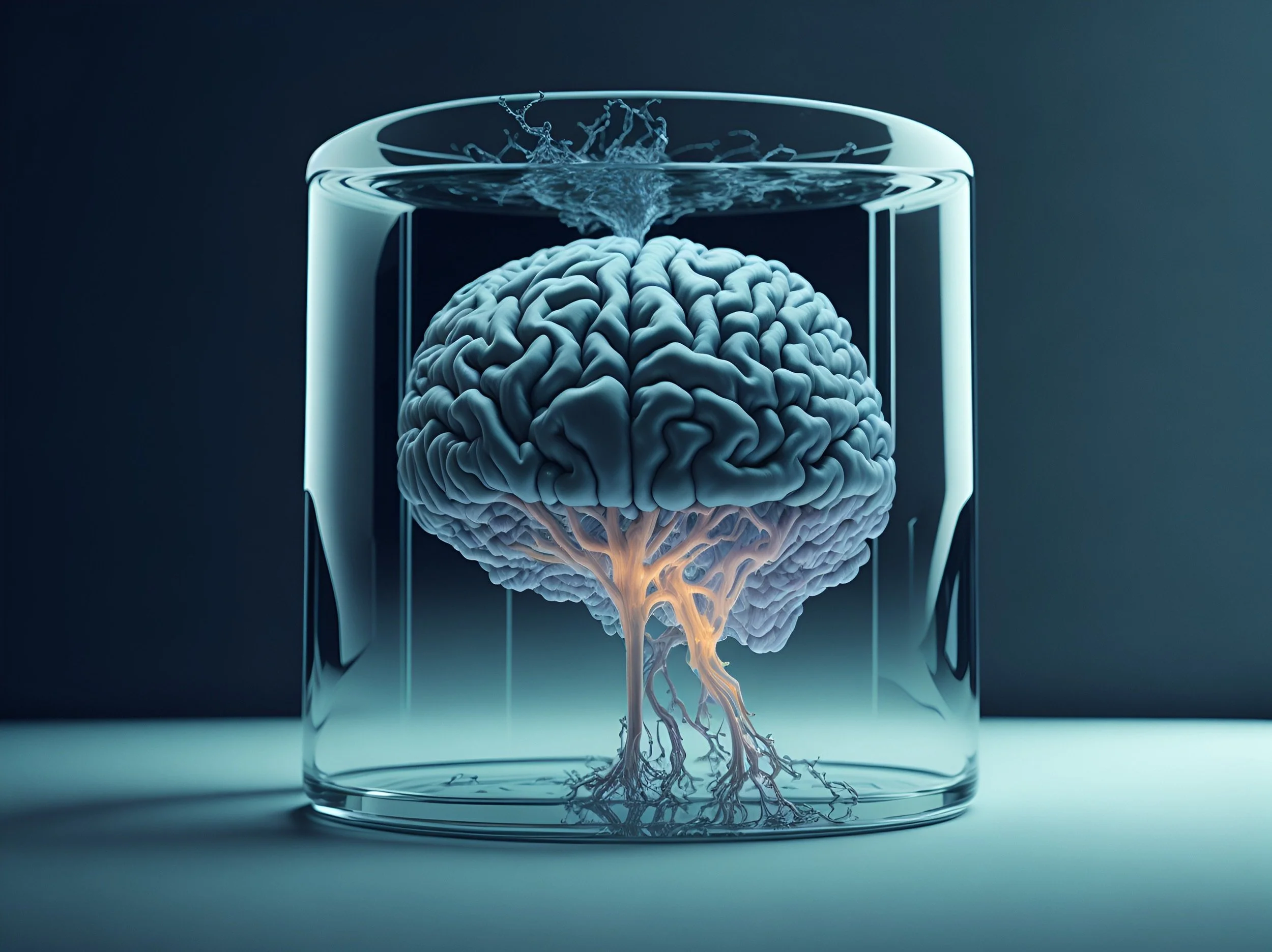
The human brain isn’t built like a single central processor—it’s more like a decentralized network of specialized regions, each working at its own pace. Different brain areas handle different jobs (like vision, memory, or movement), and they don’t rely on a single master clock. This modular, asynchronous design allows for extreme flexibility, fault tolerance, and parallel processing. For example, while your visual cortex processes incoming images, your motor system can prepare a response—each system communicating, adapting, and looping back as needed. It’s like having a team of expert collaborators, each with a specialty, working together to form a unified sense of thought, action, and experience.
Key Attributes of the Brain
Co-located memory and computation: Each brain cell (neuron) does both thinking and remembering in one place.
No central clock: Brain parts work at their own pace, without a single timing signal.
Hierarchical, recurrent, and modular: Brain areas are specialized (vision, motion, memory), work in layers, and talk back and forth in loops.
Plasticity at multiple timescales: The brain adapts quickly (short-term) and over time (long-term), even reshaping its structure.
Comparison of Brain Regions and Their AI Analogues
Frontal Lobe
Function: Planning, decision-making
AI Analogy: Controller or planner
Plain English: It’s the brain’s CEO—like the part of AI that makes decisions and sets goals.
Temporal Lobe
Function: Hearing, memory
AI Analogy: Audio processing, memory buffer
Plain English: Handles sound and memory—like audio input and short-term memory in AI.
Occipital Lobe
Function: Vision
AI Analogy: Vision module
Plain English: Processes what you see—just like computer vision in AI systems.
Cerebellum
Function: Coordination, timing
AI Analogy: Motor control system
Plain English: Keeps movement smooth—like AI that controls robots or drones.
Hippocampus
Function: Memory formation
AI Analogy: Long-term memory
Plain English: Stores life’s experiences—like a database for learned knowledge.
Thalamus
Function: Signal relay between brain parts
AI Analogy: Data router or switch
Plain English: Directs traffic in the brain—like the part of AI that routes information.
Amygdala
Function: Emotion, urgency
AI Analogy: Urgency or priority signal
Plain English: Triggers emotional responses—like an AI system that flags what’s most important.
Molecular Origins: Building the Brain from the Ground Up
At the core of brain function is gene expression (how DNA tells cells what to build), protein folding (how proteins get their 3D shape to do their job), and molecular signaling (how cells talk to each other chemically).
The brain starts with a series of highly organized biological steps:
Stem cell differentiation
In early development, special cells called stem cells turn into neurons (signal-carrying cells) and glial cells (support cells).
Genes like NeuroD and Sox2 act like software instructions, telling these cells what to become.
Axon guidance
As neurons grow, they send out long arms called axons to connect to other cells.
Chemical signals (like netrins and semaphorins) act like GPS, guiding these connections to the right targets.
Synaptogenesis
Neurons connect at synapses—tiny gaps where they exchange signals.
Proteins like neuroligins and neurexins help lock these connections in place.
Synaptic plasticity
Over time, synapses get stronger or weaker based on how often they’re used—this is plasticity, the brain’s ability to adapt.
Key receptors like AMPA and NMDA move in and out of the cell membrane, adjusting how strongly a neuron responds.
🧬 Think of this process as biological code execution: the DNA provides instructions, and proteins carry them out to build and change the brain in real time.
Brain Development: From Blueprint to Experience-Driven Refinement
The brain starts with a genetic blueprint, but experience shapes how it grows and functions.
Neural pruning
The young brain makes too many connections, then deletes the weak or unused ones.
It’s like editing rough code—removing what’s inefficient.
Critical periods
Some skills (like seeing clearly or learning language) must be learned during certain windows in early life.
If the brain doesn’t get input in time, it may never fully develop that ability.
Myelination
Axons get coated with myelin, a fatty insulation made by glial cells.
This speeds up signals, like wrapping wires in rubber.
It continues through your 20s, especially in areas like the frontal lobe (which helps you plan and control impulses).
In AI terms, the brain starts like a pretrained model, and your life experience fine-tunes it.
How the Brain Works: Computation, Storage, and Learning
Unlike traditional computers, the brain isn’t controlled by a single processor or clock. Instead, it works in a massively parallel, asynchronous way:
1. Co-located Storage and Processing
Synapses (the spaces where neurons connect) both store memory and perform computation.
Neurons take in thousands of inputs and decide whether to fire a signal—like tiny processors.
The same place that remembers also makes decisions.
2. Learning Mechanisms
Hebbian learning: "Neurons that fire together wire together." If two neurons activate at the same time, their connection gets stronger—this is how associations form.
Spike-timing-dependent plasticity (STDP): The exact timing between neuron spikes determines whether their connection strengthens or weakens.
Neuromodulation: Chemicals like dopamine (reward), serotonin (mood), and acetylcholine (focus) adjust learning rules based on the situation. These are like emotional "knobs" that tweak how the brain learns in real time.
3. Self-Directed Learning
Prefrontal cortex helps with planning, focus, and decision-making—your brain’s executive.
Basal ganglia choose actions based on predicted rewards—like an internal coach.
Default mode network turns on during rest, daydreaming, and self-reflection—maybe where your "inner voice" lives.
Memory: Short-Term, Long-Term, and Reconstructive
Memory in the brain isn’t stored in fixed blocks—it’s active, distributed, and flexible.
Working memory:
What you’re thinking about right now—held in active circuits.
Like RAM in a computer.
Declarative memory:
Facts and experiences—stored in the hippocampus, then moved to the cortex for long-term storage.
Like saving files to long-term storage overnight.
Procedural memory:
Habits and skills—stored in the cerebellum and basal ganglia.
Like riding a bike or typing without looking. Every time you remember something, you change it slightly—this is reconstructive memory. It helps you adapt, but can also lead to errors.
Awareness and the Self: The Most Elusive Frontier
Despite decades of research, consciousness—the feeling of being aware, having thoughts, and experiencing the world—remains one of science’s greatest mysteries. We know it’s real (we all feel it), but we don’t yet know how it arises from the brain’s physical structure.
Here are the leading theories that try to explain it:
Global Workspace Theory (GWT)
What it says: Consciousness happens when information from different parts of the brain is broadcast to the whole system.
Plain English: It’s like shining a spotlight on a stage—suddenly, everyone in the brain “audience” can see and work with the same info.
Why it matters: This explains why some thoughts feel present and others stay in the background.
Integrated Information Theory (IIT)
What it says: A system is conscious to the degree that its information is both highly connected and deeply integrated.
Plain English: Imagine a high-bandwidth network where everything is linked vs. a scattered collection of parts—only the tightly integrated system could be aware.
Why it matters: IIT gives a way to measure consciousness, even in non-human systems (though this remains controversial).
Feedback Loops and Top-Down Processing
What it says: The brain isn’t just reactive—it predicts, updates, and influences itself constantly through internal loops.
Plain English: What you expect shapes what you see.
Example: You can "see" a face in clouds because your brain fills in patterns.Why it matters: These self-referencing loops may be part of what makes us feel like we’re having an experience.
Embodied Cognition
What it says: Awareness doesn’t come just from the brain—it also depends on your body, senses, and even gut reactions.
Plain English: Your thoughts and feelings are shaped by how you move, breathe, and feel physically.
Why it matters: AI doesn’t have a body, so it may be missing a core piece of what makes us truly aware.
Emergentism
What it says: Consciousness isn’t a thing you add—it emerges naturally from complex networks reaching a certain level of activity.
Plain English: Like how a swarm of bees forms a hive mind, consciousness might “pop out” when brain activity hits a critical threshold.
Why it matters: It suggests we may one day build systems that accidentally become conscious.
Orch-OR (Orchestrated Objective Reduction – Penrose & Hameroff)
What it says: Consciousness might arise from quantum processes inside brain cells, specifically in structures called microtubules.
Plain English: Tiny quantum events—smaller than atoms—may help explain how thought and awareness appear.
Why it matters: It’s the most speculative theory but tries to explain why consciousness is so different from normal computation.
The Future of Artificial General Intelligence
Future Directions and Open Questions
Achieving AGI is not merely a scale or data problem—it requires answers to unresolved foundational questions:
1. Can machines possess true agency?
Goal-seeking behavior does not equal autonomy. Research must explore how agents can develop self-generated goals, persist across contexts, and adapt without direct optimization loops.
2. How do we design systems for lifelong learning?
Current models suffer from catastrophic forgetting and rigid training paradigms. Future architectures must incorporate continual learning, on-the-fly plasticity, and transfer learning from sparse data.
3. What substrates are best for general cognition?
Silicon-based neural networks may hit limits of energy efficiency and flexibility. Neuromorphic chips, photonic processors, and analog circuits inspired by dendritic computation may better support online learning and adaptability.
4. Can consciousness emerge in computational systems?
While controversial, understanding sentience—if it arises—may be essential to building agents with robust moral and ethical reasoning. Research in Integrated Information Theory (IIT), Global Workspace Theory, and predictive coding may yield insights.
5. How can agents develop values, empathy, or intuition?
Hard-coding values leads to brittle behavior. AGI systems will likely need value alignment mechanisms grounded in developmental learning, simulation of social contexts, and perhaps emotional modeling.
Towards an Integrated Approach
No single algorithm, model, or substrate will create AGI. Instead, the path forward points toward compositional architectures that synthesize the strengths of multiple paradigms:
Transformers – For perceptual grounding, sequence modeling, and linguistic understanding.
Deep Reinforcement Learning (DRL) – For trial-and-error learning, control policies, and decision-making in dynamic environments.
Neuromorphic Hardware – For online, energy-efficient, event-driven learning, mimicking the sparsity and plasticity of biological brains.
Symbolic Reasoning Engines – For formal logic, meta-cognition, and abstraction.
Biologically Inspired Memory – Systems modeled after hippocampal episodic memory and cortical working memory to support context-aware behavior and self-reflection.
Next Steps for R&D and Experimentation
To move closer to AGI, the following research and engineering domains demand focus:
1. Hybrid Cognitive Architectures
Create systems that combine neural, symbolic, and probabilistic modules into cohesive agents. This includes routing attention, integrating episodic memory, and coordinating between slow (logical) and fast (intuitive) systems.
2. Autotelic Agents
Design agents with self-generated curiosity and intrinsic motivation—capable of developing goals and behaviors without explicit external reward shaping. Techniques like empowerment maximization and homeostatic regulation offer promising frameworks.
3. Simulation-to-Embodiment Transfer
Bridge the gap between virtual simulation learning and real-world embodiment by developing agents that can generalize across modalities and environments with limited fine-tuning.
4. Self-Reflective Systems
Experiment with agents that can model their own knowledge gaps, limitations, and internal state—a crucial step toward safe meta-reasoning and learning-to-learn.
5. Value Learning and Ethical Alignment
Explore how agents can learn moral frameworks through narrative exposure, inverse reinforcement learning, or simulated social training environments.
6. Hardware Co-Design
Rethink hardware from the ground up—not just faster GPUs, but purpose-built neuromorphic and hybrid analog-digital systems that support brain-like computation, dynamic routing, and sparse updates.
Open-Source AGI Projects
An open-source ecosystem is starting to emerge, contributing foundational tools and ideas that are helping to push the frontier of AGI research.
OpenAGI – A flexible framework aiming to define modular, general-purpose intelligence architectures.
OpenCog Hyperon – A hybrid cognitive framework combining symbolic reasoning (Atomese) with neural learning for systems that can introspect and reason abstractly.
AutoGPT / BabyAGI – Early-stage autonomous agents powered by LLMs capable of recursively decomposing goals and generating action plans.
LangGraph / MemGPT – These frameworks extend LLMs with memory, persistent state, and long-horizon context, enabling more consistent and agentic behavior.
AGiXT – A modular, task-oriented agent framework that integrates planning, tools, and external APIs to simulate general-purpose cognition.
Intel’s Lava – A neuromorphic development platform focused on spiking neural networks (SNNs), offering efficient models for event-driven, brain-like computation.
These projects showcase that the path to AGI is not necessarily closed-source or centralized—it is distributed, experimental, and collaborative.
Conclusion: Nurturing Minds, Not Just Coding Them
AGI will likely not emerge from brute-force parameter scaling alone. It may be cultivated—nurtured like a child or evolved like a brain—through recursive layers of learning, embodiment, abstraction, and reflection.
The next great leap will come not from building bigger models, but from building wiser systems—capable of learning from the world, adapting in real time, and developing internal lives rich enough to reason, explore, and empathize.
AGI may not be something we simply engineer. It may be something we grow—layer by layer, spike by spike, experience by experience.